
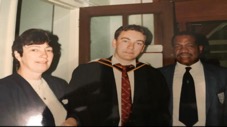
I was born in Edmonton, North London, and went to primary school in Tottenham. My real father was a magician: he disappeared when I was 8 years old, and I haven’t seen him since. He took out a second mortgage on our family home and gambled it all away. He was working as an insurance agent for a company called Prudential collecting money door to door, as they did in those days, and gambled that away too. I have a memory of him taking me to his office on the day he was sacked from his job; I guess he was trying to use me as a reason for the firm to keep him on. That tells you something of the man’s character.
What followed for me, my mum and brother were bailiffs, temporary accommodation, a council flat, a spell in hospital for me with pneumonia and pleurisy, and quite a lot of stress. Well, they do say that moving house is stressful.
Some years later, my mum met a guy who eventually became my stepfather. His name was Emerson Griffith, and he was originally from Barbados in the West Indies. He was part of the Windrush generation. When I went to secondary school, I took my stepdad’s surname and, after a few years, began calling him ‘dad’. He had a lot of good qualities and valued education. He initially started as a welder for British Oxygen before becoming a lorry driver for the Post Office (or GPO as it was then known). Outside of work, he was a football official. In the 1980s, he became the first Black linesman in the football league and refereed for many years at semi-professional level.
When I wasn’t playing football, I went to his games and watched from the stands. We became close, and I guess learning about his life really opened my eyes to how racist people could be. All the way through his life, Emerson had some significant mental health issues to contend with and he also had a problem with gambling. What are the odds on that! When he retired from his job at the GPO, he gambled away his lump sum of over £25,000 in the space of about six months and then proceeded to blame the world and his wife, my mum, for his errors. It is a long story, but he ended up kicking my mum out of the house, and a few months later setting fire to it as a protest against a court ruling, consequently invalidating much of the insurance.
Anyway, I would rather talk about my mum. All through my childhood, my mum was a constant source of encouragement and supported every interest I had. Despite the fact there wasn’t much money, she would always bring home magazines such as Look and Learn and World of Wonder, take us to the local library, and on trips to museums and famous London landmarks, always on the bus or train as we didn’t have a car.
My mum, like many working-class children of her generation, had to leave school at 15 before she could take O levels. I have no doubt she would have excelled. As testament, she has got a book at home that was she was awarded for winning the prize as the best historian in Peckham School for Girls. Mum had to get paid work in order to support her family. Her mum, my nanny Alice, was disabled and unable to work. She transferred this love of learning, especially history, to her sons; every qualification I have achieved since, I dedicate to her.
Igniting a spark
Every child needs at least one encourager or ‘sparker’ in their life, someone who opens up future possibilities and helps them to see what might be possible. Later in the book, we will talk about lucky kids, a metaphor borrowed from early years specialist and author Penny Tasoni.[1] I want to make it clear that, like Matt, I consider myself lucky to have had a mum who read to me, took me places, talked with me and set boundaries for me. But what about kids who don’t have someone like that in their lives? Should schools deliberately try to make up for that? My view is, yes, they should.
I went on to a comprehensive secondary school in London where I was pretty well-behaved bar the odd fight here and there. I might have been kicked out of a modern day ‘no excuses’ school, but I was regarded as an asset: captain of the football team, top sets, high grades and so on, and one of the few students who went on to university.
My school was a true comprehensive: a mix of people from all social backgrounds, religions and races. I had some working-class and some middle-class friends – some whose parents were reasonably wealthy. They are still my friends to this day. We have helped each other over the years, and one friend in particular has helped me through some difficult times. I would be worse off if I had closed myself off from having friends from middle-class backgrounds.
During these years, I also represented my borough, Haringey, at football. Like school, I had to travel to training and matches by bus. This was a gift because I enjoyed travelling and used that time to read. One experience playing for Haringey has really stuck with me. The team went to Holland on a football tour, and I was the only one who didn’t go as my family couldn’t afford it. All the other lads came back with new kit and shared experiences; I have never felt so left out.
First encounters with classism
It was at Manchester University that I first experienced what I have come to understand as ‘classism’ – some people treating me as inferior because I was from a working-class household. It is easy to internalise that feeling of being ‘less than’ because your family cannot pay for branded clothes. I always got my jeans and school trousers from Edmonton market. Even at university, I was still wearing hand-me-down clothes from my cousin – even underwear, and she wasn’t even my size! That feeling of being poor never leaves you. Even now, when I have the money to make a major purchase, I still go into a cold sweat of thinking I cannot afford this.
It was at Manchester where I first met people from private school. They seemed to be much more self-confident. It took me over a year to realise that confidence doesn’t equate to intelligence. One tutorial stands out for me still. A guy started talking and a bulb lit up in my head. I realised that he wasn’t bothered if he was right or wrong – in fact, he was an idiot. Me? I was scared of saying anything that might be incorrect.
Like most working-class students, I had to work while I was at university. Luckily for me, being from London, I could always pick up jobs during the holidays, such as working as a bin man or road-sweeper (I was very good, by the way, and if I had stuck at it, I could have won the prestigious Golden Broom). My jobs didn’t affect my studies, but these days working-class students face a very different labour market. They have to work evenings and weekends in bars or supermarkets, which inevitably reduces their study time.
After university, the advantage of coming from a wealthy family really kicks it. Working-class graduates simply don’t have the connections and networks to apply for certain career pathways that are dominated by the more affluent. Some do break through into the professions as barristers, doctors and so on, but it is a far tougher path. This lost talent is a massive waste to both the economy and to the well-being of those who could have had a different life path.
When I left university, I went into teaching. From 1989, I taught for twelve years in three different state sector secondary schools. I taught subjects such as economics and business studies to Key Stage 4 and 5 classes; lots of exams and lots of marking. I enjoyed teaching, but I didn’t enjoy the restrictive exam syllabuses. It felt like I was training students to pass exams, not understand the subject. Still, I proved to be pretty good at this. However, with each passing year, my enjoyment of being a teacher ‘in the system’ went down and down.
In the last few years of my full-time teaching career, I got the break that I was looking for – to work with students on a curriculum of my own design. My school decided to take the opportunity to ‘disapply’ some students from the national curriculum – that is, to remove certain Year 10 and Year 11 students from lessons such as languages and get them doing something else. These were generally statemented students; many had poor motivation and poor behaviour.
I offered to create a programme for them called Lifeskills, where I taught them for two hours a week over two years. These students learned how to analyse a film, how to revise, how to talk about yourself confidently, how to recognise your own strengths, how to cook at least five different dishes and how to present to an audience. Pedagogically, there wasn’t much writing, plenty of discussion and lots of one-to-one work (the students created career portfolios and scrapbooks); nearly all the students gained in terms of confidence, and they gathered a few certificates too.
In 2001, I left full-time teaching and became self-employed. This was during the New Labour years when it felt like there was more money in education. The experience of creating the Lifeskills course was something I wanted more of. Initially, I started training teachers in areas such as careers education and citizenship (I was on the Qualifications and Curriculum Authority (QCA) writing team for citizenship). I created numerous different training courses, and eventually ended up creating a course that thousands of teachers attended called Outstanding Teaching. Its sister course, Embedding Outstanding Teaching, aimed at school leaders, was also very popular. Both have subsequently been turned into modular school programmes involving the video analysis of teachers and strategies for leaders to get the best out of staff.
Being on the training circuit has been an interesting experience. There are lots of talented people out there, but it is surprising that some of those most respected in education are actually snobs. Some have real disdain for working-class people and working-class places. You will have to buy me a pint or two for me to reveal more.
I am now in the autumn of my career. My shampoo is called Back and Shoulders, and it is taking me longer and longer to wash my face every morning. I am now working in places like Kirkby in Merseyside, Bradford in Yorkshire, Newham in London and Fleetwood in Lancashire. I seriously love my working life. I work with great colleagues who are motivated by social justice every day. I decided a few years ago to only work in certain places and only with certain people. I have made a commitment to these communities. In each case, I am just an extra resource, a friend of the school. The core work is done by the leaders, teachers and support staff, but I hope my training and coaching with adults and young people adds something too.
There are some great individuals working in and across schools. They are motivated by fairness, justice and compassion. They are continually trying to close gaps and take daily action to support disadvantaged families. To be around them is inspiring – and you won’t get that from most other career paths.
If you are at all motivated by issues such as fairness and justice, I hope you get something from this book. I am sure you are already helping many people in your career, but my hope is that this book will influence you to help even more. Maybe you are a bit worn down by the system or the school you are in? In that case, I hope it will reinvigorate you for a few more years.
Although Matt and I were both touched by poverty in our early lives, we have written The Working Classroom to inspire everyone involved in education and from every social background. Indeed, for us, it is even more impressive when education professionals from middle-class backgrounds involve themselves in this work. In many ways, they ‘get it’ much more than some working-class people who have, by their own reckoning, progressed into being middle class and consider this was purely through their own merits.
[1] P. Tassoni, Reducing Educational Disadvantage: A Strategic Approach in the Early Years (London: Bloomsbury, 2016).
 The Working Classroom